|
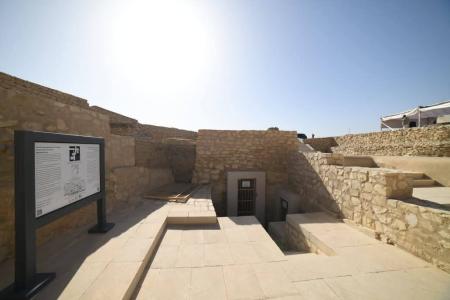
Mr. Sherif Fathy, Minister of Tourism and Antiquities, and Engineer Abdel-Mottaleb Amara, Governor of Luxor, accompanied by Dr. Hisham El-Leithy, Secretary-General of the Supreme Council of Antiquities, inaugurated today the tombs of Amenhotep Raboya (TT416) and his son Samut (TT417) in the Al-Khokha area on Luxor's West Bank. This follows the completion of restoration work and the upgrading of the surrounding area, paving the way for their opening to visitors.
The opening ceremony was attended by Mr. Mohamed Othman, Head of the Luxor Cultural Tourism Marketing Committee; Ms. Rana Gohar, Advisor to the Minister of Tourism and Antiquities for Communication and External Relations and General Supervisor of the General Administration of International Organizations; Mr. Moamen Othman, Head of the Restoration and Antiquities Projects Sector at the Supreme Council of Antiquities; Mr. Mohamed Abdel-Badi, Head of the Egyptian Antiquities Sector at the Supreme Council of Antiquities; Mr. Ahmed Hamida, Head of the Museums Sector at the Supreme Council of Antiquities; Mr. Saeed Shebl, Head of the Conservation and Registration of Antiquities Sector at the Supreme Council of Antiquities; Dr. Abdel-Ghaffar Wagdy, Director General of Luxor Antiquities; Mr. Bahaa El-Din Abdel-Gaber, Director General of Qurna Antiquities; Mr. Ali El-Batal, Director General of the Valley of the Kings Antiquities; a number of antiquities inspectors from the region at the Supreme Council of Antiquities; and Dr. Ayman Ashmawy, Advisor to the Secretary General for Egyptian, Greek, and Roman Antiquities.
The Minister expressed his delight at being in Luxor Governorate, given its ongoing achievements in the field of antiquities preservation. He emphasized his pride in the opening of the two tombs after the completion of their restoration, stressing that the preservation and protection of antiquities is a top priority for the Ministry, ensuring their sustainability for future generations.
He described the tomb restoration project as an "extended journey" that began in 2015 and culminated in success in 2026. He thanked the Governor of Luxor for the fruitful cooperation and coordination, and for the Governorate's full support of the Ministry's efforts. He also expressed his appreciation to all those working in the tourism sector and his colleagues at the Ministry of Tourism and Antiquities, particularly at the Supreme Council of Antiquities, for their contributions to the project's progress.
He noted that the Ministry's vision is based on consolidating Egypt's position as a leading global destination for Egyptologists, commensurate with its unique cultural richness. He affirmed that Egypt will remain a major center for archaeological discoveries worldwide. In this context, he explained that work is underway to establish a specialized training center to offer advanced training programs that will attract researchers from around the world.
The Minister also emphasized the importance of strengthening cooperation with the private sector to operate services at archaeological sites and museums to improve the tourist experience. This cooperation must be conducted within a framework of clear regulations and standards that define roles and responsibilities, contributing to the development of services, enhancing the visitor experience, and supporting increased revenue. He stressed that managing and preserving these sites remains an inalienable responsibility of the Ministry, while maintaining the necessary balance between development and preservation. He noted the need for clear plans and performance indicators to measure the results of this cooperation.
He pointed out that the Ministry's strategy, under the slogan "Unparalleled Diversity," reflects the unique characteristics of the Egyptian tourist destination. He affirmed that achieving the target of 30 million tourists is a realistic goal that requires continued work on developing the hotel and aviation sectors, which is currently being implemented. Regarding performance indicators, Mr. Sherif Fathy explained that the tourism sector witnessed a growth rate of 15.6% during the first quarter of this year. He noted that the effects of regional tensions remain relatively limited, given the proactive measures taken by the Egyptian state. He affirmed the Ministry's commitment to continuing to implement further measures to ensure the sector's recovery is accelerated.
Mr. Sherif Fathy made a point of honoring the restorers who contributed to the restoration of the two tombs, presenting them with certificates of appreciation in recognition of their outstanding efforts and their active role in completing this important project.
For his part, the Governor of Luxor welcomed the attendees to the ancient Theban necropolis, pointing out that Luxor still holds many archaeological secrets, with new discoveries constantly being made thanks to the efforts of the Ministry of Tourism and Antiquities and Egyptian and foreign archaeological missions.
The Governor of Luxor added that the governorate has received numerous international accolades, including being chosen as a capital of cultural tourism, and emphasized the ongoing efforts to develop the city in a manner befitting its historical and global touristic significance. He also confirmed the early start of preparations for the new tourist season, which begins next October, noting that next July will witness the implementation of projects within the presidential initiative "Decent Life" on the West Bank. These projects include the construction of sewage networks and lines that will contribute to lowering the groundwater level and protecting archaeological sites from its dangers.
The Governor of Luxor stressed the governorate's full support for the efforts of the Ministry of Tourism and Antiquities and the governorate's antiquities sector, with the aim of diversifying the tourism product, opening new markets, and attracting more tourists to the governorate's archaeological and tourist destinations.
Dr. Hisham El-Leithy, Secretary-General of the Supreme Council of Antiquities, affirmed that the opening of the two tombs represents an important addition to the archaeological sites, given their historical value.
He described the tombs as having a distinguished historical and archaeological significance, noting that this reflects the importance of the Theban tombs and commemorates their owners and their role in ancient Egyptian civilization.
He explained that the work was not limited to archaeological restoration alone, but also included developing visitor services, such as directional and informational signs, sunshades, and the preparation of a bilingual (Arabic and English) scientific brochure, ensuring a comprehensive tourist experience that combines the antiquity of the site with high-quality services.
In the same context, Professor Moamen Othman, Head of the Restoration and Antiquities and Museums Projects Sector at the Supreme Council of Antiquities, indicated that the restoration work included removing debris, uncovering important archaeological finds, reinforcing ceilings and walls, meticulously restoring inscriptions and scenes, carefully cleaning the original colors, installing modern lighting systems, and upgrading the security and surveillance system.
Professor Mohamed Abdel-Badi, Head of the Egyptian Antiquities Sector at the Supreme Council of Antiquities, explained that the two tombs were discovered during excavations carried out by the American Research Center in Egypt in March 2015, while searching for the entrance to the tomb of Djehuty (TT110). He noted that the two tombs were covered with rubble and had suffered significant damage. They were also used for mass burials during later periods, up to the Byzantine era.
It is worth mentioning that the two tombs date back to the New Kingdom. The tomb of Rabua dates to the reign of Thutmose III, while the tomb of Samut dates to the reign of Thutmose IV. Both tombs follow the T-shaped architectural style, a common style for noble tombs during the Eighteenth Dynasty.
The tombs contain a distinctive collection of scenes depicting daily life (agriculture, harvesting, and industries), the making of bread, pottery, and wine, fishing and hunting, as well as scenes of banquets and celebrations within the transverse hall.
The longitudinal hall also contains funerary scenes depicting the tomb owner, including the sarcophagus being pulled on a sledge, the funerary furniture being transported to the tomb in the presence of Osiris and Hathor, scenes of the Opening of the Mouth ritual, and a unique depiction of the goddess Renenutet nursing a royal child, along with scenes of the false door and ancestor tributes.
It is worth noting that excavation work resumed in September 2020 during the COVID-19 pandemic and continued until the 2021 excavation season. This work included debris removal, well drilling, and initial restoration work.
|